
AI Crawler Monitoring in Your AI CMO
See which recognized AI crawlers and agents request your website, which pages they reach, why they visit, and where technical coverage breaks. It is one module of your AI CMO.
Server-side tracking · Live request stream · Provider-level filters · No browser pixel
See when AI systems reach your website
Watch a real Claude request appear inside Brand Armor AI as it happens. Confirm which AI agent reached your site, the exact page it requested, and why the request was classified.
- Verified server-side requests
- Requested page and AI agent
- Live purpose and timestamp data
Stop treating every AI bot request as the same signal
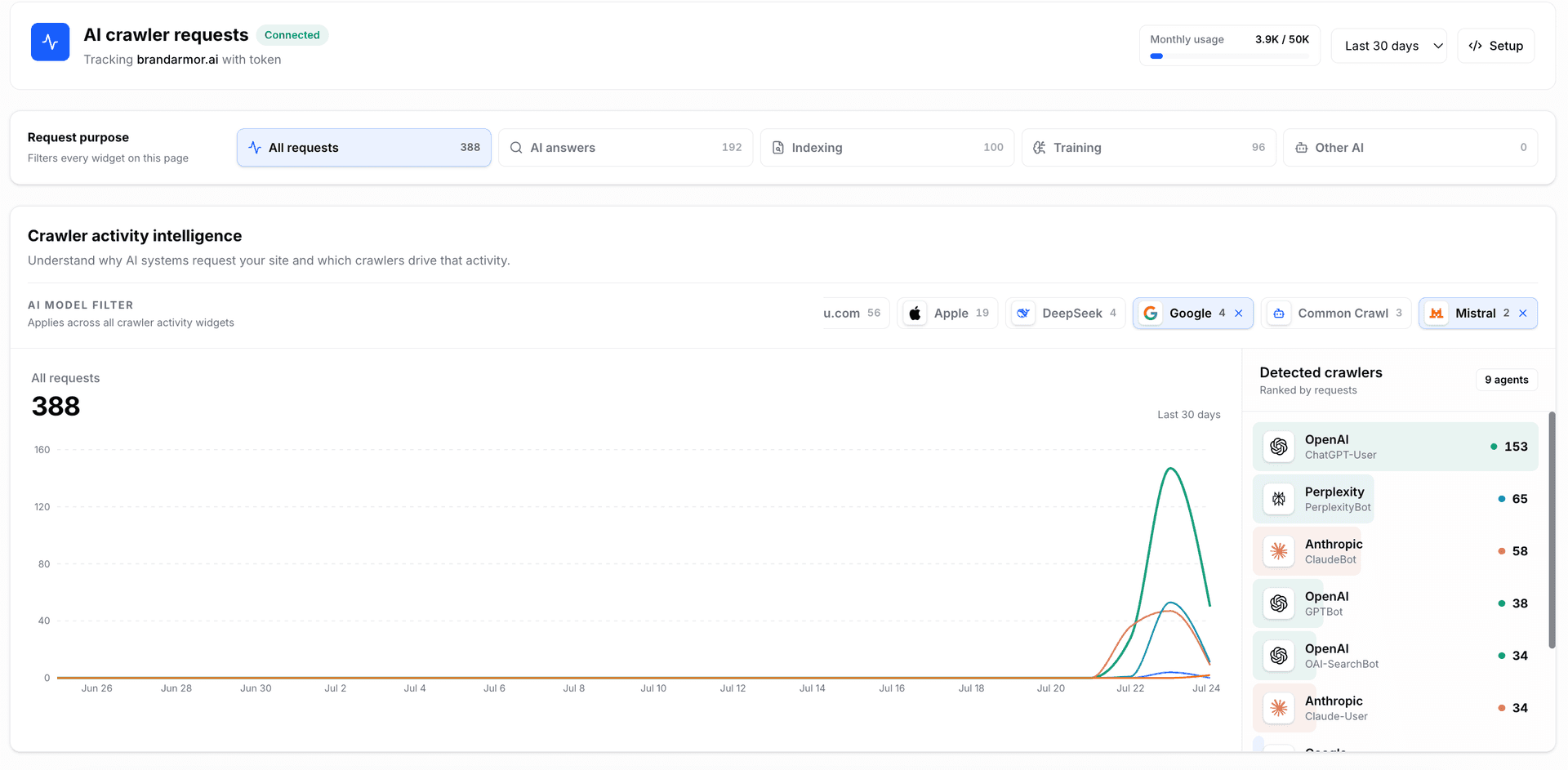
A training crawler, a search crawler, and an agent fetching a page for an answer represent different events. Brand Armor AI separates recognized requests by purpose and lets the same top-level filter update the activity chart, requested pages, live stream, coverage matrix, and network-origin view.
AI answer fetches
Separate user-triggered retrieval agents from broad background crawling so you can see when an AI system requests a page to help form an answer.
Search and indexing
Identify crawler activity associated with AI search discovery and inspect the exact routes receiving those requests.
Training crawlers
Keep model-training crawler activity distinct from answer retrieval and AI search activity instead of combining every bot into one total.
Other AI agents
Review recognized AI traffic that does not cleanly fit answer, indexing, or training categories while preserving the underlying crawler identity.
Watch requested pages and recognized agents in one live view
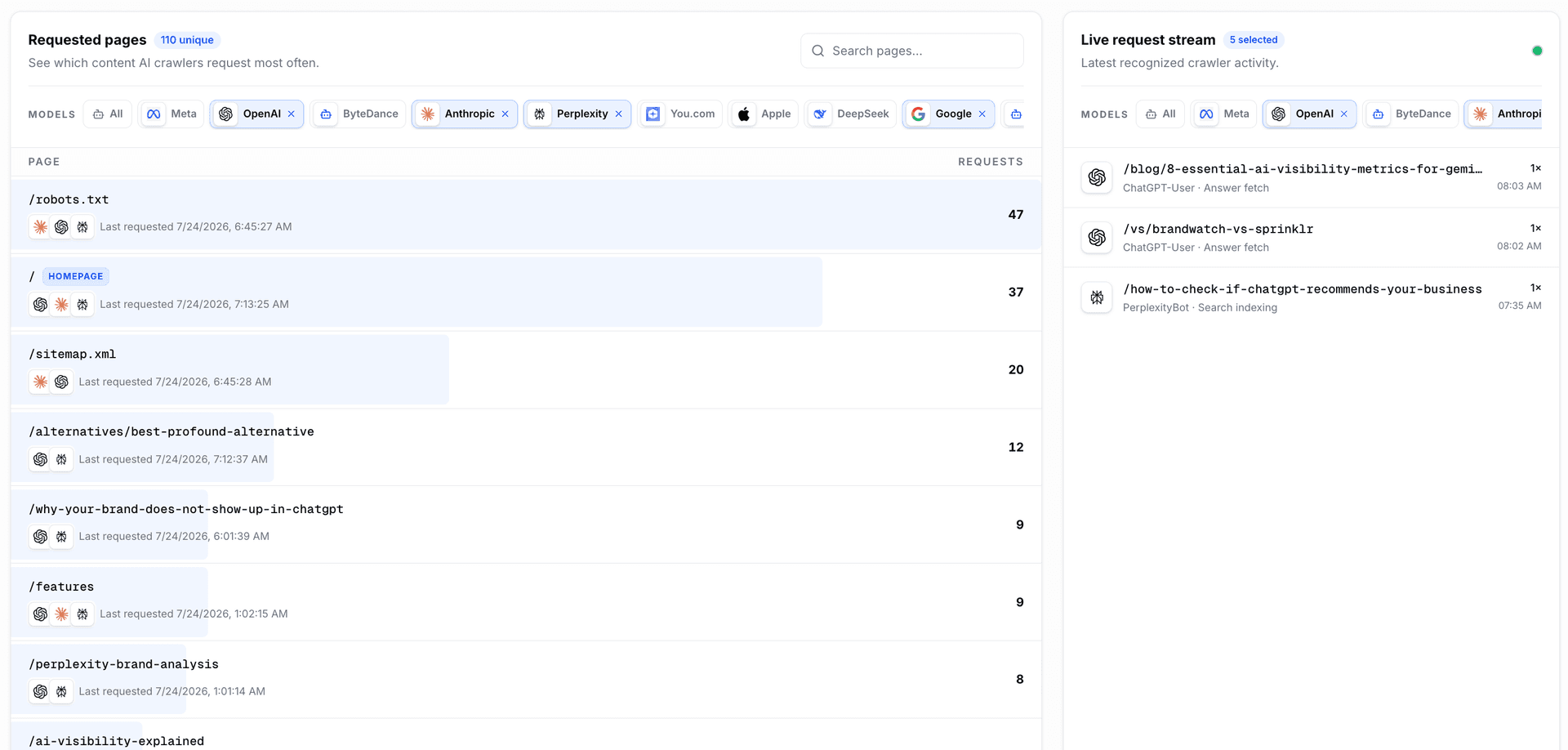
Search the URLs AI systems request most, compare request volume, inspect the last request time, and filter by provider. The live stream shows the latest recognized activity with the crawler identity and classified purpose.
This gives SEO, GEO, content, and engineering teams shared evidence from the server instead of relying on browser analytics that many crawlers never execute.
Find page-level coverage gaps by AI provider
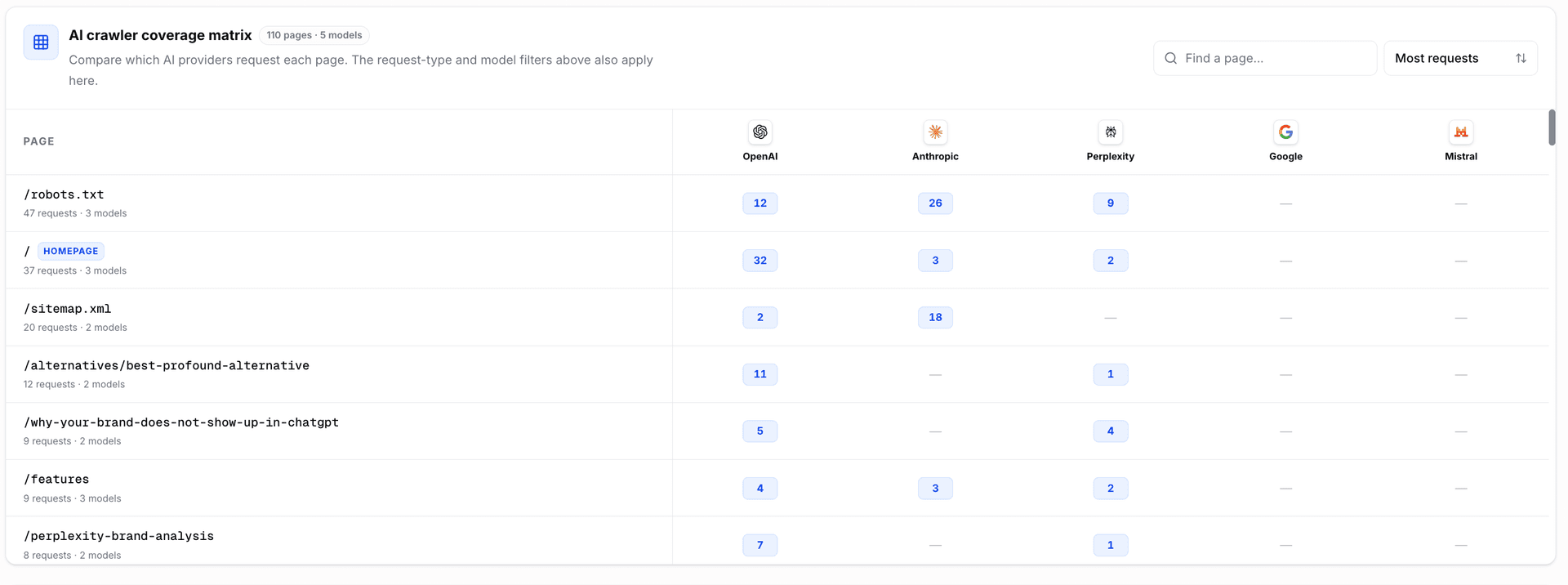
The AI crawler coverage matrix compares requested pages across providers. Search for a priority URL, sort by request activity, and see whether OpenAI, Anthropic, Perplexity, Google, Mistral, or another recognized ecosystem has reached it.
Understand crawler infrastructure origins without pretending it is user location
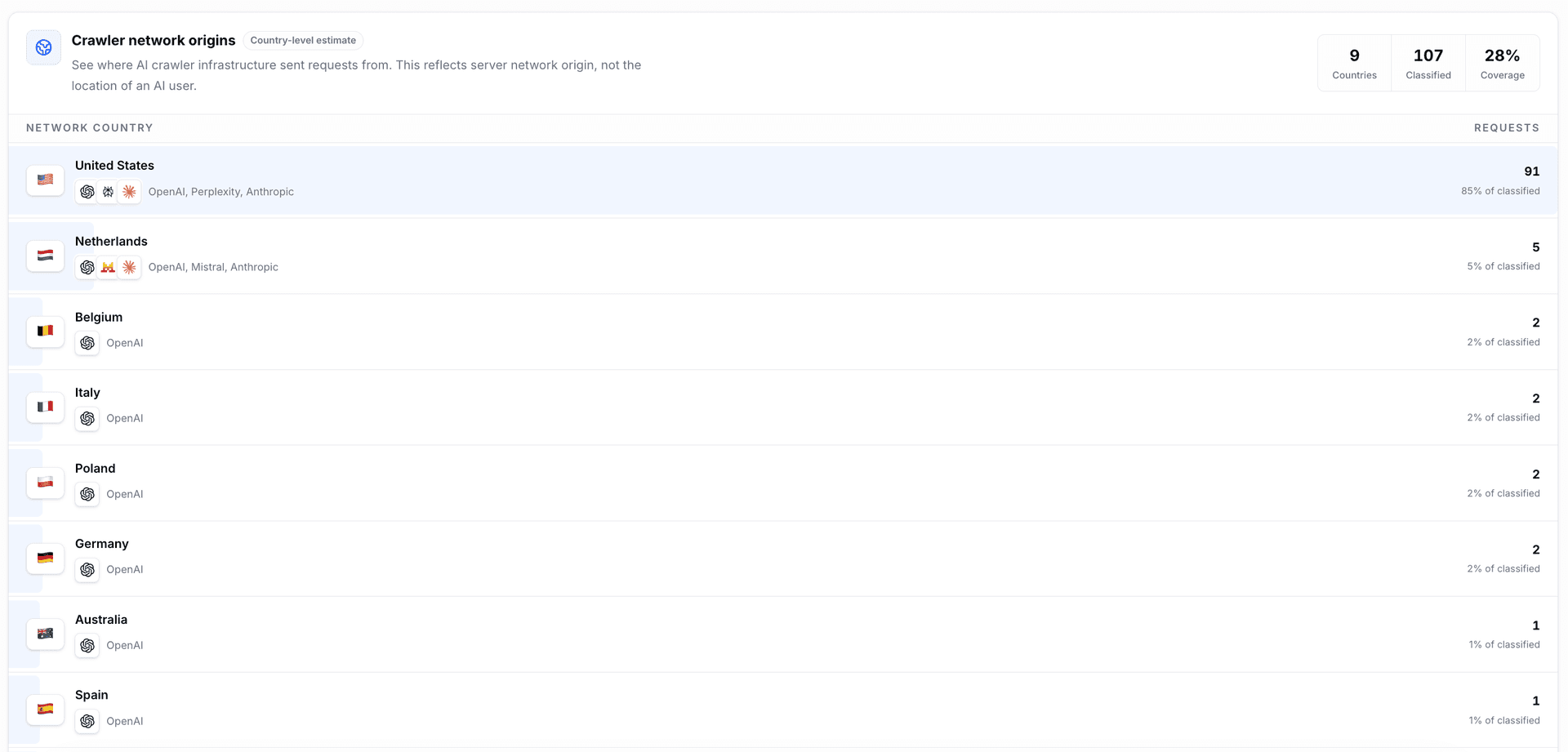
When trusted platform metadata is available, Brand Armor AI groups classified requests by estimated crawler network country. This can help technical teams understand infrastructure patterns and unclassified coverage.
Interpret this correctly. Network origin reflects crawler infrastructure, not the location of a person using ChatGPT, Claude, Perplexity, or another AI service.
A crawler request is one layer of AI search visibility
Crawler access matters, but it is not the final business outcome. Brand Armor AI keeps technical access, generated answers, citations, and content actions connected without collapsing them into one misleading metric.
- Crawler monitoringConfirms that a recognized AI crawler or agent requested a URL on your server.Observed server request
- Prompt monitoringShows how AI platforms answer the buyer questions your team tracks and whether your brand appears.Observed AI answer
- Citation intelligenceShows which owned and third-party sources appear as supporting references in captured AI answers.Observed citation
- Content gapsTurns missing coverage, weak sources, and competitive losses into pages and updates your team can ship.Prioritized action
Use real crawler activity to decide what to investigate next
The useful question is not only “did an AI bot visit?” It is whether the right systems can reach the right commercial pages, whether those pages influence answers, and what prevents your brand from being recommended.
- Investigate pages AI repeatedly requestsCompare high-crawl pages with prompt results and citations to learn whether access is translating into useful AI visibility.Open AI Visibility Explorer
- Find models missing important pagesUse the page-by-provider matrix to spot coverage gaps, then review robots, source strength, and answer-ready content.Check crawler guidance
- Connect crawler access with competitorsWhen AI can reach your content but still recommends competitors, compare positioning, citations, and recommendation share.Review competitive intelligence
- Turn evidence into publishable improvementsMove from crawler and answer signals into briefs, content gaps, blog drafts, and prioritized page updates.Explore the Content Gaps Engine
Server-side setup for modern web stacks
Install the Brand Armor AI package, add the website ID and crawler token to the server environment, then connect the adapter for your runtime.
npm install @brandarmorai/ai-search-crawler- Next.js
- Express
- Cloudflare Workers
- Cloudflare Pages
- Hono
- Bun
- Deno
Purpose-built collection boundaries
- Runs on the server and keeps the crawler token out of browser JavaScript.
- Tracks eligible GET and HEAD requests from recognized candidate user agents.
- Removes URL query strings by default and excludes API, framework, and static paths.
- Uses fail-open delivery so analytics does not block the website response.
Live AI crawler monitoring FAQ
What is live AI crawler monitoring?
Live AI crawler monitoring records recognized server requests from AI crawlers and user-triggered AI agents. It shows which crawler requested the site, which URL it requested, when the request happened, and the crawler purpose classification available for that user agent.
Does a crawler request prove that a page was indexed or cited?
No. A request proves that a recognized crawler or agent reached the page. It does not by itself prove indexing, model training, citation, recommendation, or inclusion in an AI answer. Brand Armor AI keeps crawler activity, prompt results, and citations separate so teams can evaluate each stage correctly.
Can crawler monitoring reveal the prompt a person entered?
No. Standard crawler requests do not expose the original user prompt. User-triggered agent activity can indicate that an AI system fetched a page while forming an answer, but the exact question remains private to the AI platform.
Which AI crawlers and agents can Brand Armor AI recognize?
Brand Armor AI classifies recognized candidate user agents associated with major AI ecosystems, including OpenAI, Anthropic, Perplexity, Google, Meta, Mistral, DeepSeek, You.com, Apple, and other supported crawlers. Detection coverage can expand as providers introduce or change crawler identities.
Does the country view show the AI user location?
No. Country data is a best-effort estimate of the crawler infrastructure network origin when trusted hosting metadata is available. It is not the location of the person using an AI assistant, and the dashboard labels it accordingly.
How is AI crawler tracking installed?
The server-side Brand Armor AI package supports Next.js, Express, Cloudflare Workers and Pages, Hono, and Fetch-compatible runtimes including Bun and Deno. The workspace provides a website ID and server-side token during setup.
Does crawler tracking slow down the website?
Tracking is designed to be fail-open and not delay the visitor response. The server package evaluates recognized candidate user agents, tracks eligible GET and HEAD requests, removes query strings by default, and keeps the crawler token in the server environment.
How is this different from Google Analytics?
Browser analytics primarily measures human sessions and client-side behavior. Many AI crawlers do not execute browser analytics scripts. Brand Armor AI records eligible crawler requests on the server, then connects that technical signal with AI visibility, prompt, citation, competitor, and content-gap workflows.
See when AI systems reach your website
Start collecting real crawler request data, connect it with AI answer visibility, and turn technical access into a clearer optimization workflow.