
How to See Which AI Crawlers
Visit Your Website
To see which AI crawlers visit your website, read the user agent in your server logs. GPTBot, ClaudeBot and PerplexityBot identify themselves in each request. Google Analytics usually misses these visits because its tracking script does not run for crawlers.
Why Google Analytics can't see AI crawlers
If you're relying on standard web analytics to monitor AI traffic, you're missing the full picture.
Browser-based Analytics
Tools like Google Analytics, Mixpanel, and Amplitude rely on JavaScript executing in the user's browser (client-side).
Server-side Detection
Server-side tracking monitors the actual HTTP requests hitting your server or edge network, before content is served.
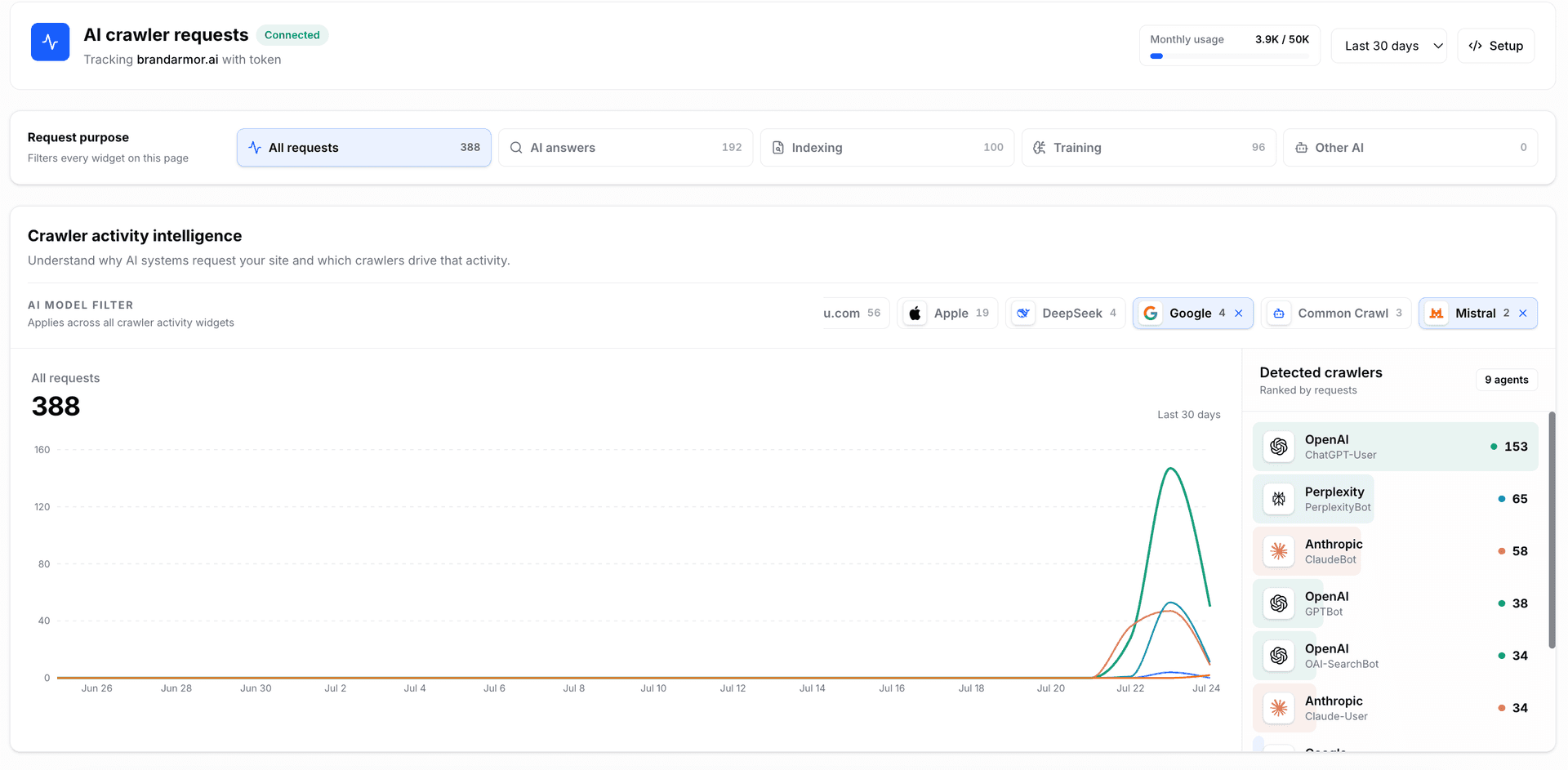
The AI crawlers visiting your website right now
Different AI companies use different bots for different purposes. Here are the main crawlers you should be tracking.
See AI crawlers in action
Watch how Brand Armor captures a request from an AI agent fetching a page.
See when AI systems reach your website
Watch a real Claude request appear inside Brand Armor AI as it happens. Confirm which AI agent reached your site, the exact page it requested, and why the request was classified.
- Verified server-side requests
- Requested page and AI agent
- Live purpose and timestamp data
Track AI crawlers on your website in 3 steps
Brand Armor provides an easy-to-install middleware package that identifies AI bots and securely logs their visits.
Install the package
Add the official Brand Armor AI Search Crawler package to your project using your preferred package manager.
npm install @brandarmorai/ai-search-crawlerBRAND_ARMOR_WEBSITE_ID=your_id BRAND_ARMOR_CRAWLER_TOKEN=your_tokenAdd credentials
Set up your environment variables with the credentials provided in your Brand Armor dashboard to securely link your traffic.
Connect your runtime
Import and apply the middleware in your application. It works seamlessly with modern edge and server runtimes.
How to track GPTBot visits to your website
When tracking OpenAI's traffic, it is crucial to understand the difference between GPTBot and ChatGPT-User.
GPTBot is OpenAI's web crawler used to build the massive datasets that train future foundational models (like GPT-5). If you see GPTBot, your content is being indexed for training.
ChatGPT-User is a retrieval agent. When a user asks ChatGPT a specific question, and ChatGPT decides to browse the web to find the answer, it uses the ChatGPT-User agent. Seeing this means a real user is currently querying AI about topics related to your page.
Tracking both allows you to measure both your long-term model training inclusion and your AI answer engine visibility.
How to track ClaudeBot visits to your website
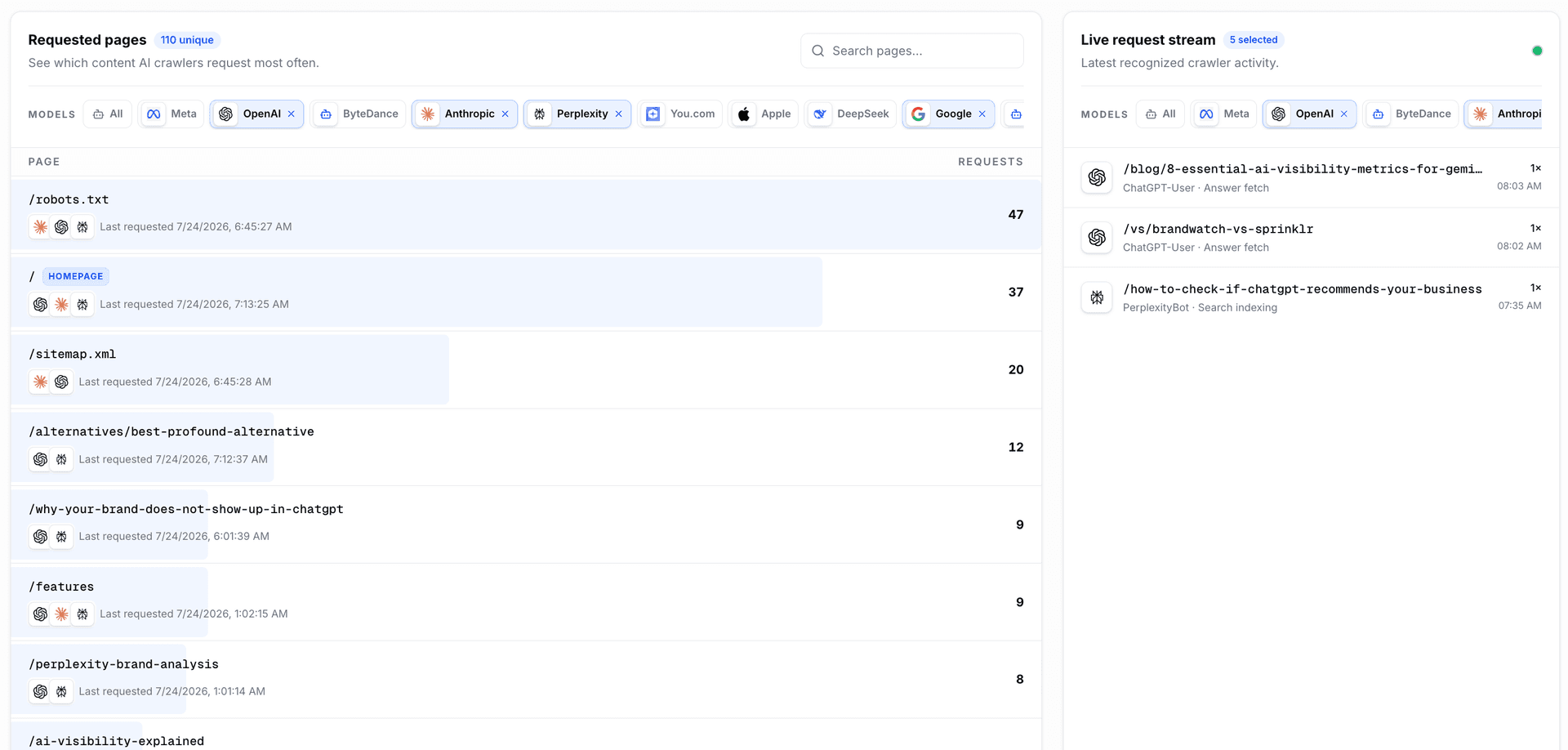
ClaudeBot is Anthropic's primary web crawler. Similar to OpenAI, Anthropic uses ClaudeBot both for building training datasets for the Claude family of models and for web retrieval.
When ClaudeBot accesses your site, it means Anthropic considers your content authoritative or relevant to a specific user prompt.
By monitoring exactly which URLs ClaudeBot requests, you can infer which of your products, blog posts, or docs are most heavily relied upon by Claude users. If ClaudeBot frequently visits your technical documentation, for example, developers are likely asking Claude how to use your tool.
ClaudeBot Activity Surge
Recent change in AI crawler requests
How to track PerplexityBot visits to your website
PerplexityBot powers Perplexity AI, the leading AI answer engine. Unlike traditional search engines, Perplexity reads your pages and synthesizes answers directly, providing inline citations.
Tracking PerplexityBot is critical because Perplexity relies on up-to-date web crawling. A visit from PerplexityBot often directly precedes your website being cited as a source in a Perplexity answer.
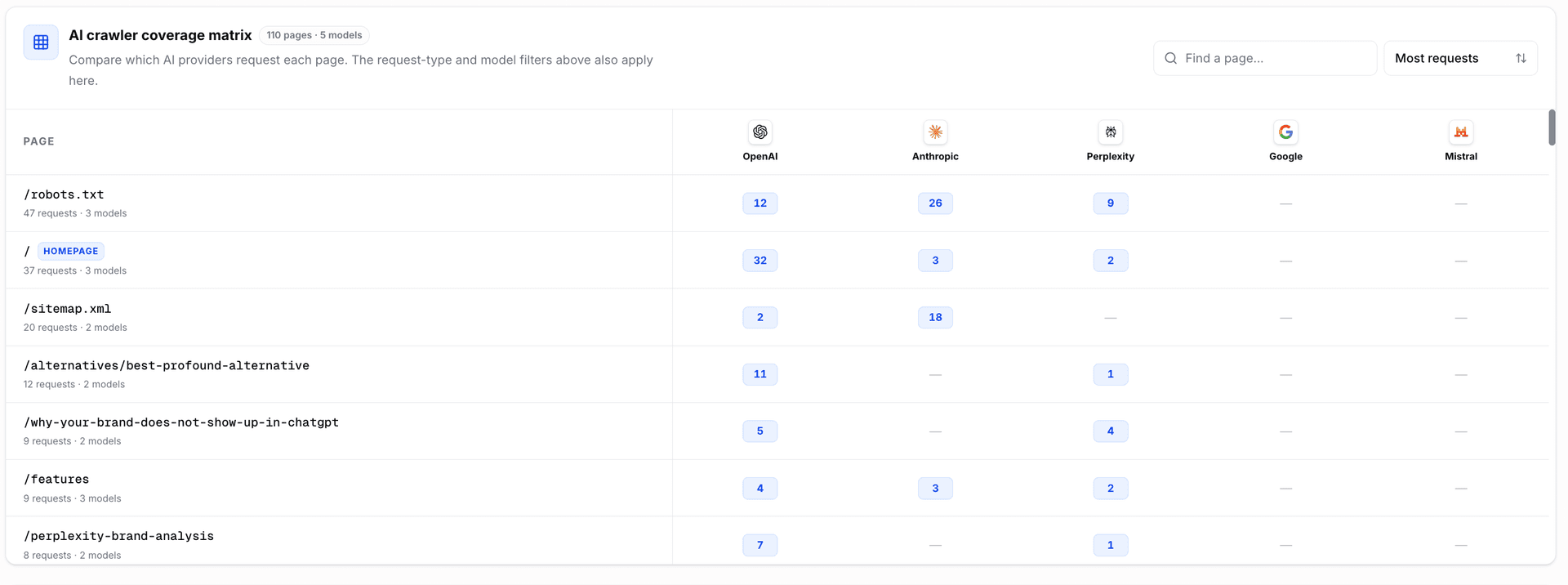
Brand Armor's coverage matrix allows you to map PerplexityBot visits against your top priority URLs, ensuring the AI answer engine has ingested your most critical marketing pages.
A crawler visit is one layer of AI visibility
Seeing the crawler is step one. Understanding how the AI actually interprets and recommends your brand is the full picture.
1. Crawler Access
Monitor GPTBot, ClaudeBot, and PerplexityBot fetching your content.
2. Prompt Answers
Track exactly what AI models say about your brand when users ask.
3. AI Citations
Measure how often your website is cited as a trusted source.
4. Content Gaps
Find gaps in observed AI answers and turn them into useful content.
Frequently Asked Questions
Everything you need to know about AI crawler monitoring.
What is an AI crawler?
An AI crawler is an automated bot operated by AI companies like OpenAI, Anthropic, or Perplexity to index web content for their language models and answer engines.
How do I know if GPTBot is visiting my website?
You can track GPTBot visits by monitoring your server logs for the "GPTBot" user-agent, or by using a server-side analytics tool like Brand Armor.
Does a crawler visit mean my content appears in ChatGPT?
Not necessarily. A visit from GPTBot means your content may be indexed for training, while a visit from ChatGPT-User means ChatGPT is actively retrieving your content to answer a user query.
Can I block specific AI crawlers?
Yes, you can block AI crawlers by adding rules to your robots.txt file, such as Disallow: / for specific User-agents like GPTBot or ClaudeBot.
What's the difference between GPTBot and ChatGPT-User?
GPTBot is used to crawl the web to train OpenAI models, whereas ChatGPT-User is used by ChatGPT to fetch content to answer specific user prompts.
How often do AI crawlers visit websites?
It depends on your website authority, update frequency, and whether users are actively prompting AI engines with questions related to your domain.
Does ClaudeBot visit every website?
ClaudeBot visits websites that are relevant to the queries users ask Claude, or as part of Anthropic's general web indexing efforts.
Can I see what page an AI crawler requested?
Yes, with server-side monitoring tools, you can see the exact URL path, timestamp, and user-agent of every AI crawler request.
Is AI crawler tracking different from regular bot detection?
Yes, traditional bot detection often aims to block malicious traffic, while AI crawler tracking focuses on identifying and analyzing AI agents to understand how your brand is represented in AI.
How do I install AI crawler tracking?
You install it as server-side middleware in your web application framework (like Next.js or Express) so it can inspect incoming HTTP requests before they are processed.
Start seeing AI crawler activity on your website
Use Brand Armor to monitor your AI search visibility and track GPTBot visits.